How to Retain Information From Reading
A practical reading case study: turn scattered highlights into a few connected explanations, useful questions, and a manageable review habit.
Read guide
 ez-learn
Personalized reviews
Keep reading. Keep checking what you remember.
You can understand a chapter today and struggle to recall it a week later. That's normal. The harder part is knowing what to revisit without starting the whole book again.
ez-learn helps you stay in touch with what you've learned. Questions during reading, concept-level progress, and follow-up sessions after you finish your book give you a clearer idea of what still needs work.
Start studying freeNot every part of a book needs the same amount of attention.
You might remember one concept easily but keep mixing up two others. Reviewing every page equally takes time without necessarily addressing the gap.
ez-learn tracks your estimated understanding of individual concepts as you answer questions. Each concept has a mastery score from 0 to 5, along with a status that can help indicate whether it needs another look.
The score isn't a verdict on what you know. It's a working estimate based on your practice, and it can change as you learn and as time passes.
As you work through your book, you'll answer questions about the sections you've just read. During longer books, ez-learn also brings back previously studied concepts at certain points.
These review sets pay attention to concepts that need work, rather than simply repeating everything in order. You get another chance to recall an idea while you're still moving forward through the book.
That matters because a chapter doesn't exist on its own. An idea introduced early on may help you understand something several sections later.
A single quiz score rarely tells the whole story.
In ez-learn, questions are connected to concepts from your book. Your answers update estimated mastery at the concept level, so you can see where you're making progress and where you may need more practice.
You can explore concepts individually, return to their source material, and inspect related ideas in your knowledge map. When an answer doesn't go well, you have a clearer place to start than “reread the chapter.”
Finishing the book isn't the end of the learning process.
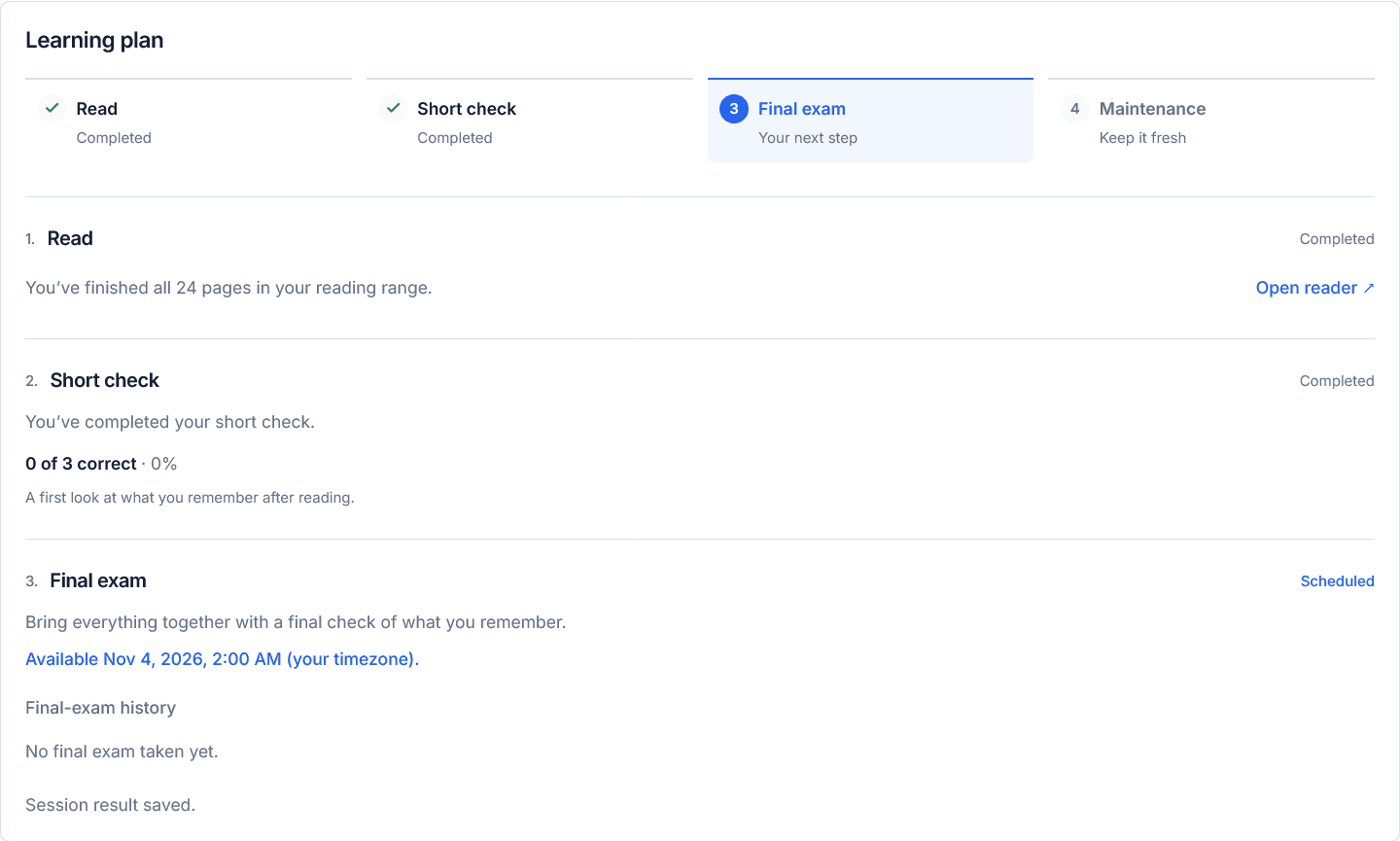
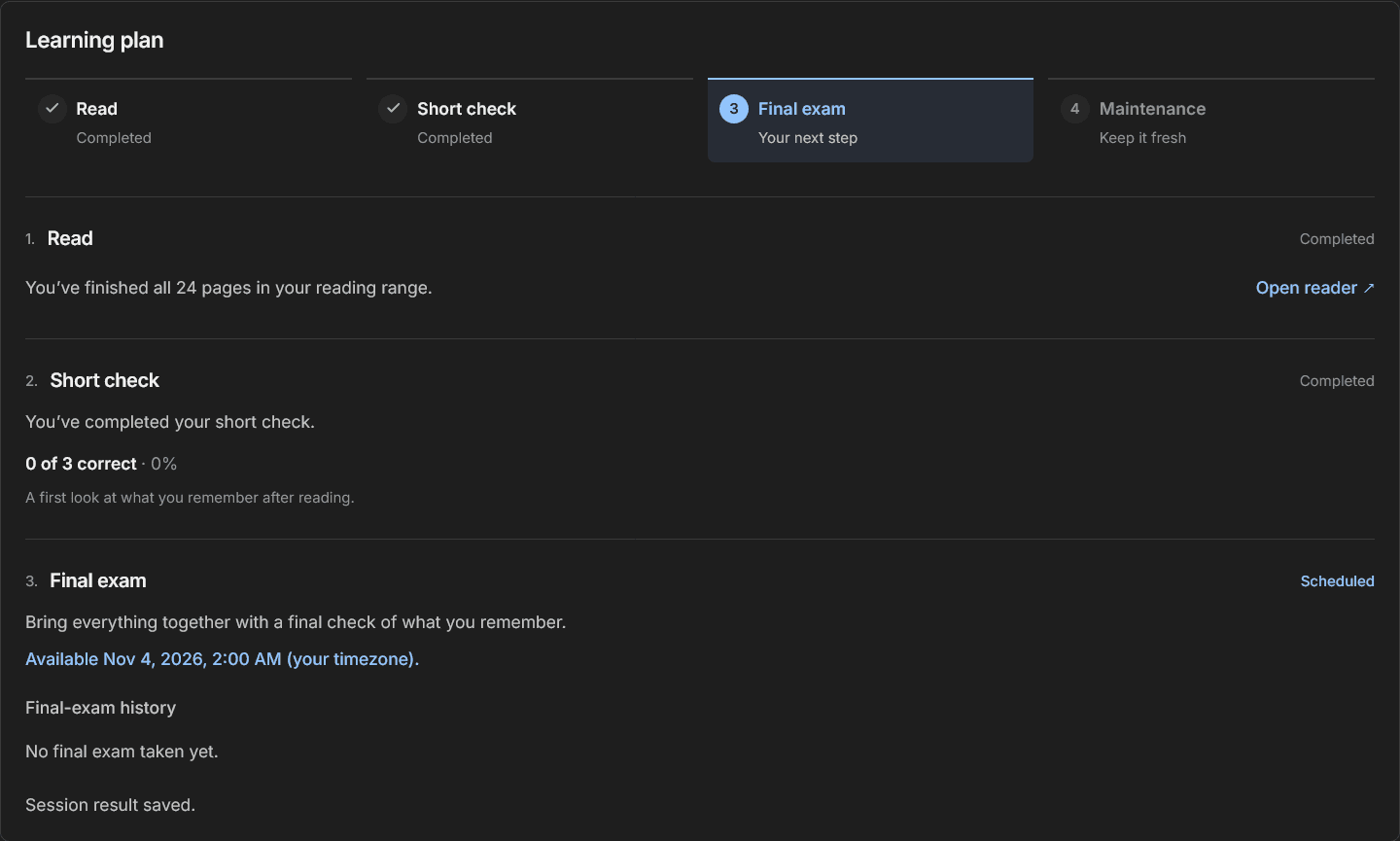
After you’ve completed your reading range, take a short check, then a final exam when it becomes available. These assessments check your understanding and identify concepts that need another look. After completing the original final exam, you can retake it and view your previous results.
Maintenance follows the final exam. Your learning plan shows when a maintenance check is available; availability depends on eligible concepts and question coverage.
These sessions prioritize concepts that may need attention. You can also use optional practice to work on selected concepts after reading.
Your learning plan shows the next available action without starting a test automatically.
There's a reason an explanation can feel obvious while you're reading and difficult to produce later. Recognizing an answer and recalling it are different tasks.
Research on retrieval practice suggests that bringing information to mind can support longer-term learning. Research on distributed practice also finds benefits to spreading study across time instead of concentrating it all into one sitting.
Neither method removes the need to understand the material in the first place. But together they offer a useful approach: read carefully, test what you remember, return to the parts you missed, and revisit the material later.
That's the role reviews play in ez-learn. They help you do something with the knowledge after you've first encountered it.
1. Read your book. Work through manageable sections with the original source available when you need it.
2. Answer questions. Check your understanding after each section and encounter earlier concepts again during eligible reviews.
3. See what needs attention. Inspect concept mastery, review status, and the ideas behind missed questions.
4. Continue after reading. Take the short check and final exam, then continue with maintenance checks and optional practice. You can also retake the final exam.
You don't need to keep a separate list of everything you might forget. Your reading and reviews belong to the same learning journey.
No. Reviews consider your progress and which concepts need attention. Depending on the session, the system can prioritize weaker concepts instead of treating everything as equally urgent.
Review opportunities are built into the learning journey, but you still complete the questions yourself. Some reviews occur during reading; after reading, the learning plan offers a short check, a final exam with optional retakes, and maintenance checks when available.
Reviews are distributed over time, and the learning system considers changes in estimated mastery when selecting concepts. ez-learn isn't a conventional flashcard scheduler, so it's more accurate to think of it as guided learning with built-in review and follow-up practice.
Yes. After the book reaches the maintenance phase, optional practice lets you revisit selected concepts, and other practice options may be available depending on your book's progress.
You put time into reading your books. Give what you've learned a chance to stay with you.
ez-learn helps you check your understanding as you read and return to the concepts that need more work afterward.
Start studying free