

An AI tool can produce a summary much faster than you can read a chapter. That makes it useful for some tasks, but a polished summary is not evidence that you understand the book. It can also omit a qualification, flatten an argument, or confidently introduce something the source does not say.
A better study workflow gives the tool a specific supporting job and gives you something to do independently. Keep the source close enough that you can check both the output and your own understanding.
Read the source first
Begin with a short section of the book. Identify its main question and attempt a brief explanation before consulting an AI-generated account. This gives you a point of comparison and makes it easier to notice an interpretation that differs from the author.
If you need help choosing a starting point, use the chapter's headings, introduction, and exercises to establish its scope. A preliminary overview can orient you, but return to the actual passage for the reasoning and qualifications.
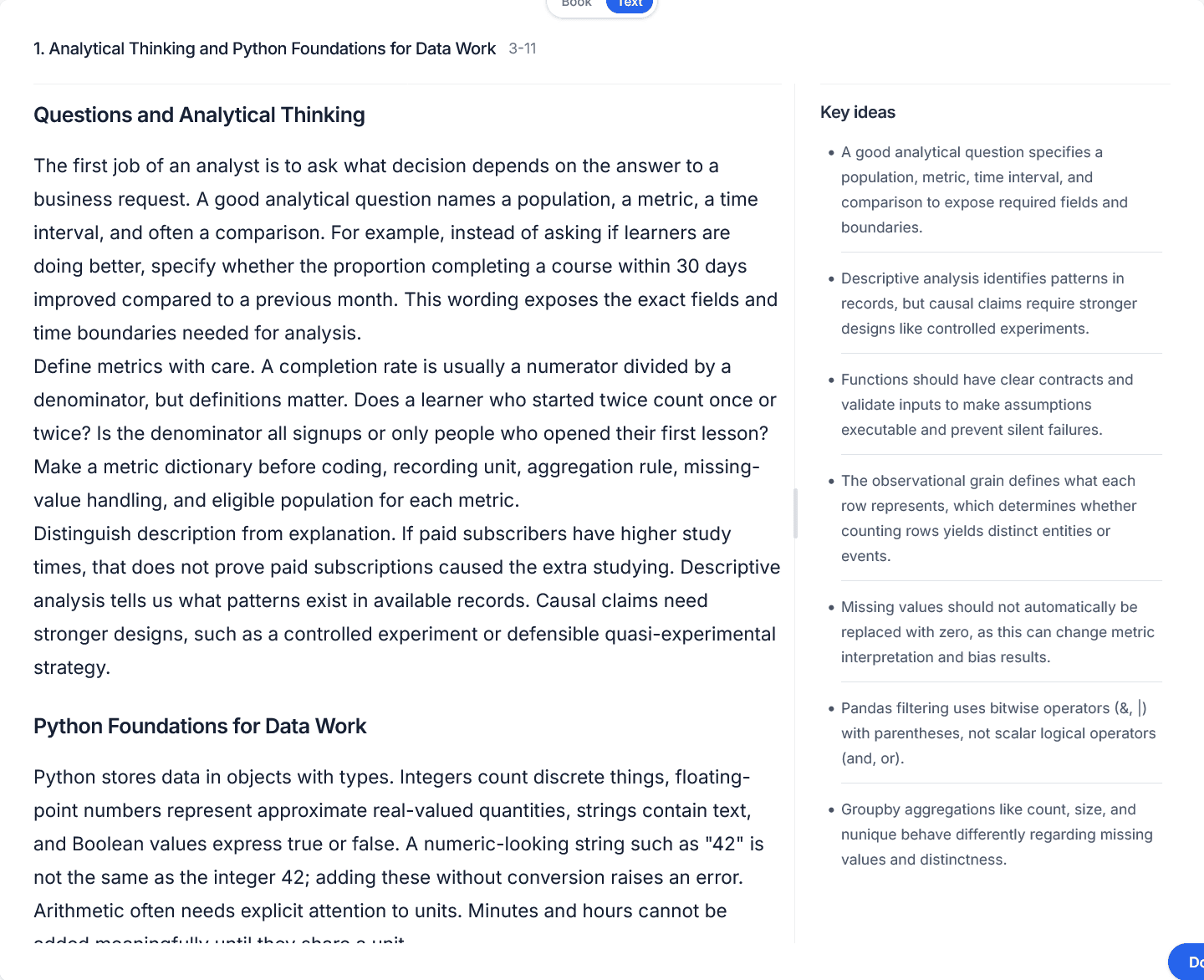
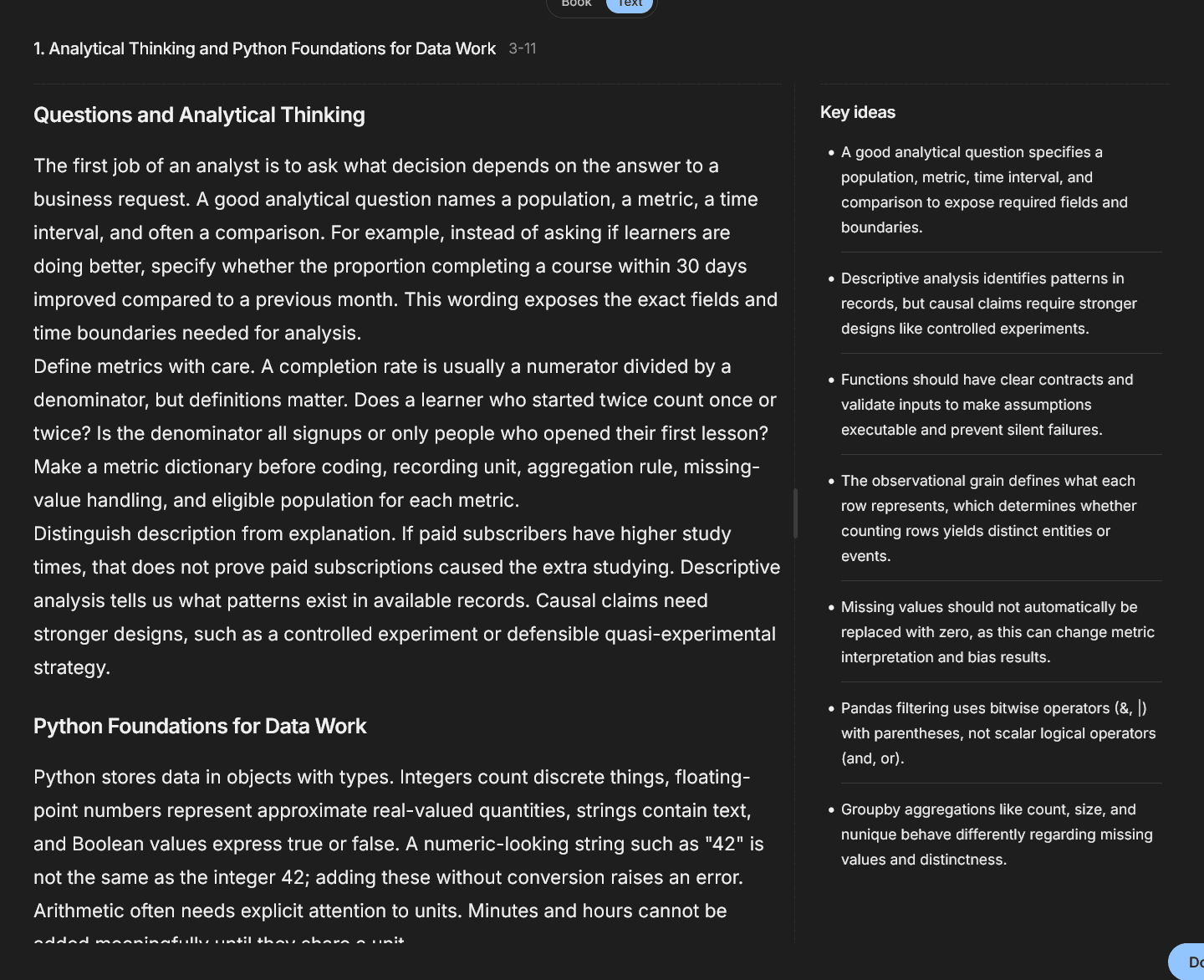
In ez-learn's guided reader, the original book remains alongside prepared key ideas. Treat those ideas as guidance for the reading task. They are a reason to look more carefully at the source, rather than a reason to stop reading it.
Give the tool a bounded job
If you use an AI assistant that supports working with source text, try a request that has a clear purpose and a result you can check. Here are three starting points.
Clarify one difficult passage
Try: Explain this paragraph in simpler language. Keep the author's conditions and distinguish the explanation from any example you add.
Compare the result with the original. Has a cautious claim become absolute? Has an example been presented as something the author said? If the simplification changes the meaning, use the discrepancy as a question to investigate.
Generate a question instead of another summary
Try: Ask one question that requires explaining this relationship. Do not show an answer until I have attempted it.
Answer with the source hidden. Then check both your answer and any suggested feedback against the book. A question that depends on material outside the section may need to be rewritten before it is a fair test.
Examine your explanation
Try: Here is my explanation of the passage. Identify a missing condition or an unsupported inference, and point to the supplied text that supports your feedback.
A requested quotation or reference still needs checking. Do not assume that an apparently precise citation is real or that it supports the claim attached to it.
Check the output before it becomes a note
| AI output | Your check | A reason to revise it |
|---|---|---|
| A shorter explanation | Compare its claim and conditions with the passage. | It turns “may” into “will” or omits an exception. |
| A new example | Work through why the example fits the concept. | It illustrates a different idea or relies on an unstated assumption. |
| A study question | Confirm that the source lets you answer it. | It is ambiguous, gives away the answer, or requires unrelated knowledge. |
| Feedback on your answer | Locate the source evidence and inspect the reasoning. | It rewards fluent wording while missing a factual error. |
| A reference or quotation | Open the actual source and verify the relevant text. | The reference is missing, inaccurate, or unrelated to the claim. |
You do not need to perform this as a formal checklist after every sentence. Use it to notice where output can quietly become trusted material. A mistaken note can be rehearsed just as readily as a correct one.
Keep part of the work independent
After using the tool, close its answer and explain the idea again. Give your own example, solve a related problem, or reconstruct the argument. Check the result afterward.
This creates a useful separation between receiving help and seeing what you can do with it. If the explanation only works while the generated answer is visible, choose a smaller task and try again.
The evidence for retrieval practice concerns the learner's act of recalling, not the mere availability of generated questions. Roediger and Karpicke's work offers a reason to include your own attempts; it does not establish the effectiveness of a particular AI product.
Leave a traceable study record
Keep three things together: a question, your checked explanation, and a reference back to the relevant passage. Label a generated example as an example. Separate an author's claim from a tool's interpretation and your own inference.
When a later chapter changes the context, update the note. An accurate summary of one section can still be incomplete for the book's larger argument. Source references make those revisions much easier than a folder full of disconnected responses.
Avoid saving every output. Keep the items that support a learning goal, and return to important questions later without looking at the answer first.
A practical place for AI in book study
Use AI where it reduces friction around a real reading task: finding a way into a difficult explanation, preparing a focused check, or organizing concepts you will examine. Keep judgment about the source and your own understanding with you.
Interactive book learning in ez-learn brings reading, questions, concepts, and review into one journey. For the underlying study routine, follow how to study a textbook or how to use active recall.
Research reference
Roediger, H. L., & Karpicke, J. D. (2006). Test-enhanced learning.
Put this into practice with ez-learn.
Make reading more active with ez-learn. Work through books in guided sections, answer questions, explore concepts, and review what you've learned.
Explore interactive book learning